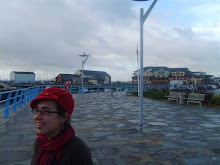
On Sunday, Sara Gordon and I went on a hike, walking along the river from Mass Ave to LaSalle Park, and on to the Marina, where we spent some time with the fish. Then we wandered through some weird condo communities--although that is probably not the right word for what they are--singing Woody Guthrie, and into downtown where we walked through a fence, cut under the overpass, and headed north and west, to home.
There's been a lot of fuss about the waterfront lately. Some people want this thing, some people want the other thing. Bass Pro wants in and that's its own kettle of fish. The word revitalization gets thrown around a lot (gets thrown around on Grant St. too). I'm not saying there isn't room for improvement. There are a few gravely spots that could be greener, and I'd never say no to a few more trees--but revitalization? Revitalization? Come on! There were easily five hundred people at the waterfront around 6 pm on Sunday. Easily 500, but probably more. Laughing, shouting, playing, running, walking, playing tag, grilling. Doing people-at-the-waterfront activities. It's a river. We live on a drained swamp. Of course people are going to go there.
We do need to protect what is already ours from Bass Pro and from any further condo-ization. We need to hold what is rightfully ours away from any of the greedies upstairs. But we do not need to revitalize. We already are. And this argument reaches right into the core of urban planning itself. Do we need to protect what is ours from that corrupt mascot, money? Yes. Beyond that, nothing needs to be done. People will put what they need where they need it, and they invest where they are. Academics, posturers, politicians: take a walk (not a drive) around the west side. There are countless churches, temples, and other sanctuaries...in houses. The west side says, "Everything can go in a house!" Nobody is going to build their church or garden across town. They are going to get together and put it where they live. I have walked on rainy nights, and heard, from the yellow glow of houses, voices rising up in languages I don't know, and tambourines, and guitars, and instruments I don't know--voices that laugh and sing and sway the night, and people like me stop in the street to listen. They're thanking god--in whatever version of that story--and I'm thanking them. A little help is good, but usually there is too much meddling.
It's an odd process--the one by which a simple thing is made complicated. The river is the calmest, loveliest place of the city. It is my medicine. I go to the river to remember what I am doing, and to forget (I make sure to go there at least once a week). But the waterfront is already segregated. Along the path Sara and I took, it was like this: quiet, private (hidden boat docks), then public (kids jumping into the water), then private again (gated 'communities' without gates), mostly quiet--a murmur of AC units and ceiling fans. Then noisy: there was a condo party going on. At the Marina it is public and private. How? Shanghai Reds versus picnic tables.
When I was trekking through Belfast this past March, I kept finding myself walking along a mesh fence. At points it was as tall as a short building. It is an old fence that remains, but it is anything but symbolic for the people who still live, and cry, and somehow manage to sing and play behind it. There were playgrounds behind it, on the other side of where I was walking, and the shouts of the children were not ordinary shouts; they were cries of war. As they should be: what does it do to anyone's mind--child or adult--to live behind a fence? For any human or animal to be put in a cage creates daily pain, and that stuff gets inside bodies. The message is: You cannot go where I am; stay. The trauma of that lives in our muscles, in our cells. Take Belfast, take Palestine, take domestic abuse. There is claustrophobia first, then terrorism--terrorism directed outward or inward. In Belfast, I was amazed at how difficult it was to find an entrance/exit to the fence. I walked along it for at least a half an hour, but maybe longer, before I found a place to slip through--and that was all it was--not a gate, just a place to slip through.
I thought of this as we passed through Buffalo's hidden monastery of wealth. There was no fence or physical barrier keeping us from entering or exiting, yet we were walking straight into a secret. A tar path led us straight from LaSalle Park into an enclave of suburbia in downtown Buffalo. But there were signs that read Private. A cop car drove by us, slowly. That's a loaded image in Buffalo. A cop car. Who sees one, and doesn't get a tick inside? Who even lives here, we asked each other? Are these summer-in-the-city condos? Who are these strange people, and what is inside their bodies? (The answer is a sort of ultimate kind of fear). And then, although their wall, their fence, their keep the outside-outside partition was semi-fluid and self-imposed, I felt so sorry for them. How horrible for anyone to be so stuck. And how sad it must be to live on the edge of a beautiful river, and be afraid to share it.
These were my Sunday reflections in a nutshell. I'll say this: if you always pass through your city in a car, you don't see it. Not all the way. It's not all your fault. It's actually impossible because you are going so fast, and you are inside walls, and you have other important things to concentrate on (like not hitting that jerk)! A bike ride is good, and sometimes a walk is even better, but either way, go visit your city. Take a vacation day and gift yourself a cultural education.
While "Rude boy" blared above, from an air conditioned apartment in the sky, this is what Sara and I sang, as we walked away:
"As I was walkin'--I saw a sign there
And that sign said, 'No tresspassin'
But on the other side, it didn't say nothin'
Now that side was made for you and me!"
Sunday, 23 May 2010


Tuesday, 18 May 2010
The Capitalist and Me (2010)
For Anais Nin and Mary Sarsfield
but only physically.
And it was good.
It was the best I ever had.
I let a capitalist in,
but only physically,
and afterward
I went out into the street
with not an ounce of
shame or
hate--
I went out his door with--
!
Yes
Tell you what
my name is
Scherezade
Call me
Esther if you must
change my name.
Don't you know
What it means
?Anyway
What I took
What I gave What I took from him
is bigger
BIGGER than you=
We are discussing
What Ilya conquered in bed
What Geryon conquered in death
What Mother Teresa created in her life time
Period
Baby
Full moon
Yes
We cannot fail to mention
Molly Bloom,
of course
there is more to it than
Yes--
Molly didn't stop loving
when you spilled over the edge
of the page.
Hey brother
Cut me some slack and
call me Jezebel
if you want.
But oh I feel good.
Oh I'm the best I ever
had
Yes.
Tuesday, 4 May 2010
What we are given
We live in a culture in which, above all else, confrontation and unpleasantness are to be avoided, things are to be smooth as Knob Creek, but this comes at a price. Twice in the past two weeks, I've been called a "bitch" (among other, nastier words) by strangers, and it was because things were not as smooth as Knob Creek, and I said so. I simply don't accept the mantra of all encompassing pleasantness. We don't always have to take what we're given. If we're not hungry, for example, we don't have to take food. And we definitely do not have to take other people's shit.
When Bush was sitting in the oval throne room, we were, generally, collectively, paralyzed with fear--the much discussed, media-imposed fear. There's a lot to unpack about that. Firstly, what 'media imposed' means. Who, or what, thing or organism is the media? How does it exist and who sustains it--corporations and the government, or me and the people I know? Is it a monster or an anthill? And is 'it' really responsible for our fear? How does such an broad, undefinable entity impose anything on us at all? How is it that during Bush's presidency we became conscious of the media's role in our inability to live fully, and were still affected by it? And how is it that we seem to have forgotten the role it plays now?
My questions barely scratch the surface of what went on. Those eight years were rife with trauma: two wars begun illegally (are not all wars outside the law?), an economic draft, minds and bodies irreparably damaged, funds taken from children, who, as we all know, were all left behind, in order to stock the arsenal. And, so that those children, uneducated, might later stock the arsenal too. There are all the gaping wounds behind the Patriot Act: house arrests, wire-taps, and the wrongfully accused. There was Hurricane Katrina, the drama of which turned out to be more about racism and lack of humanity than it was about the hurricane. There was the invention of the "partial birth abortion." Behind all of these appellations, of course, are cavernous worlds of stories. And tied up in those stories is a lot of pain, which we all carried around (and still do), and I think, guilt as well. In 2004, Bush was re-elected, and many Americans cried. In 2004, Victor Yanukovych was elected, and many Ukranians took to the streets.
And now Obama is in office. We are a happier, more lighthearted country, but let me ask you why. Is it because our education system is being repaired? Is it because we are no longer at war? Is it because we have more civil liberties or because women in need have greater access to the healthcare they need? Or, is it because instead of using words like "terrorists," and phrases like "with us or against us," Obama uses words like "hope," "unity," and "perserverence"? He gives us ego boosts, and tells us regularly how strong and good we are. He emanates pleasantness, and so, he has our compliance. We like him, and that is why he is trouble.
Are we really better off now? Has Obama really undone the damage of the Bush administration? It may not be possible to undo, but has he stopped the madness? Are we not still at war? If you've had enough of my questions, here are some facts: the 2010 federal budget includes 663.7 billion for the Department of Defense (a 4% increase since Bush's last budget), and another 42.7 billion dollars for the Department of Homeland Security (also an increase since Bush), while the lowly little Department of Education receives a lowly little 46.7 billion dollars. The Department of Energy, by the way, receives 26.3 billion, a small dive from 2009's projected 33.9. (The figures here do not include $$ from the Recovery Act--and by the way, why does the Department of Defense need recovery money--for bombs?)
The numbers tell us something that might hurt a little: Obama's numbers are more conservative than Bush's. Ouch, ouch, and ouch. We may be sleeping better now, but at whose expense? The answer is ours. The answer is that Obama is not the answer. I repeat, Obama is not the answer. You are.
I'm lucky to have friends who do a lot of good. Some of them are community organizers. And the question has been going around: was Obama really a community organizer, and did he change when he went into politics, or was his people's man identity a media construction? Well, I asked FactCheck.org, and here was their timely response:
Q. Was Obama really a community organizer?
A. Yes, that was his job title when he was hired out of college.
I felt nothing when I read this. It confirms nothing. He was a community organizer and he changed, or he was playing hookey with a resume builder. The fact is, it doesn't matter. Why waste time brooding over lost love?
Problems don't go away because you look at them. Don't take what you take because it is what you are given. Take what you need, what you deserve. Trust yourself. Self-affirm. Act. And if you don't know where to start, start with a garden.
Tuesday, 27 April 2010
The same city as me (2008)
Knowing you live in the same city as me is like knowing the pantry's stocked, or that the river's there, if I want it, even if I can't see it, even if I'm just sitting at my desk.
Your name pinches me.
And god is an atom.
Friday, 23 April 2010
Nightwind (2010)
for Eleni
nightwind
Oh
if you should enter to find me
zipped up
and preparing
for the full sleep granted only to travelers--
Alone, between worlds, I am one even in my own city.
My lullabye is my own love
vast for you
warmer than even you
night wind.
lover.
How do I move oceans,
how do I leave continents
for my other half,
while my sister is without me?
But it is
this:
My love is my only lullabye
and with this much of it
how can I be lonely?
how can I be cold?
Wednesday, 21 April 2010
A Sweater Is (2005)
A bicycle that you love and love and love and love until it is stolen or lost or if you are lucky, used until it wears down to dead-beat brakes and shone tires. When the paint is peeled and the spokes are rusted—that is when it has been loved too thin to keep you warm, and you will throw it in a chest of other old bicycles in the attic, to forget, but not trash, on account of sentimentality.
Wednesday, 14 April 2010
Jane Greatall
I went to see Jane Goodall on Wednesday night. She was speaking in the gym at Canisius College and the queue went right down Main Street, then wrapped around West Delavan. The line was moving...well, barely at all. Despite this, everyone was calm and patient and without complaint. It reminded me of when the Dalai Lama came to UB and for the 3 days he was in town, although there were actually more people on campus, it felt like less because nobody was pushing one another to get through doors. And forget fame--that is what the presence of a very special kind of person does. I saw old people and young people; everyone felt like-minded and simpatico. Even Erik Starchild was there. The two Canisius women in front of me had gym bags and were eating donuts. What I really wanted at the moment was a juicy hamburger. It was nearly 8 pm, I'd worked hard all day and hadn't had dinner, but I didn't mind. I reflected on this as I sat down. I was one of the last 20 people admitted and yet because of the way they seated us, I had an incredible seat, very near to Jane's profile. I was reminded of a bit of Barthelme, who wrote:
...and that it is good to leave a few crumbs on the table for the rest of your brethren, not to sweep it all into the little beaded purse of your soul but to allow others, too, part of the gratification, and if you share in this way you will find the clouds smiling on you, and the postman bringing you letters, and the bicycles available when you want to rent them, and many other signs, however... (Barthelme, City Life, Farrar, Strous, 1970).
I dropped out of my rat-race job in order to spend all of my time meaningfully, and of my own design. Wednesday was my first night of freedom and I felt, sitting on those bleachers, waiting for Jane--we were encouraged by an introductory slideshow to think of her as "Jane"--that I'd been brought letters--she hadn't said a word yet. When she did begin, she told us how humbled she was that we had all come to see her, ("I know some of you saw me peering at you as we drove up, and you recognized me"). To thank us for coming, she said hello in chimpanzee. We laughed, we clapped, our hearts were warm. I should age half as well! I thought.
By way of introduction, she said, "Nobody can do anything alone," and thanked her mother. It was her mother, she said, who was the reason for everything, for her success. Jane's story is incredible. From the age of tiny, she wanted to go to Africa to study animals. But to go to Africa at all, which is now an attainable dream for a hard working lady scholar, was laughable. There were no study abroad programs then, and she was the wrong sex. Plus, her family was dirt poor. There were very few scholarships given, and they were only given to those who excelled at languages. Although she knew everything there was to know about the animal kingdom, Jane did not excel at languages. Her mother advised her to learn to become a secretary, and get a job in Africa. Jane did, and then proceeded to pay a visit to her future mentor, the paleontologist, Louis Leakey. She wowed him with her animal knowledge, and soon after, began to work for him. And just as the six months of funding he had was about to run out, Jane came upon a chimp in the forest, who was dipping a stick into a mound of insects and putting it to his mouth. Then he began stripping the bark off the stick: toolmaking. Louis Leakey got more money. Thus Jane became a research scientist before she had had an ounce of secondary education. It wasn't until much later that she got her PhD.
For my friends who couldn't make it, I want to share Jane's message, which I found so inspiring I turned down a Salman Rushdie ticket later in the week (I didn't think I would be able to process everything). The following is a sample, and less eloquent synopsis, of what Jane said, as I remember it:
We're not separated from the animal kingdom, we're part of it. Between their constant evolution, and our own continual revolution into our animal nature, the line between 'us' and 'them' gets blurrier all the time. Chimps are our relations enough to us to give us blood transfusions, but we don't need to look that far to see that we are part of the animal kingdom. Anyone with a dog knows that animals have personalities, intellect, and feelings. So what is it that makes us different from the others? The main difference between us and chimps is this explosive intellect: language. It is our ability to talk about things that are not present: we can talk about the past, and plan for the future. Above all, we can discuss the issues and questions in our lives. And so, how is it, with the unbelievable and magnificent tool of language, how is it that we are destroying our home?
How? We've lost wisdom. The wisdom of religious ancients and elders, who asked, when it was time to make decisions, "How will this effect the community in the future?" and not "How will this effect me now?" or even "How will this effect my job? my country? in three months?"
(Verbatim): Do you think there's a disconnect between this clever brain and the human heart? Everybody cares about their children and grandchildren, but they act as if they don't. There's a disconnect. But we cannot live through a single day without making a difference. The question is not if you do, but what impact you're going to make. What do you eat and how do you eat it? What do you wear? How do you get from A to B? When you arrive, how do you talk to people? These are the choices that add up.
Jane then talked about what brought her to leave research and teaching (which she loved) and become an activist surrounding environmental and social problems in Tanzania. You can read about her work here and here.
Of her hope and faith that we humans will manage to come around, and fix these massive environmental and social problems, she said, "Maybe I'm naive and simplistic, but it works for me." She also discussed how closely linked these two issues are: "Poverty," she said, "is one of the great destructors of the environment". Jane gave three talking points on hope, and I realized that my dad has been saying exactly these things for years, and I've always disagreed with him.
Reasons to hope:
1. The human brain. We are innovative; we have a way of problem solving. We are not always good at it, but we manage, particularly when our backs are at the wall.
2. The unbelievable resilience of nature. This has been a big one for my dad. The lesson hit home today when I was gardening at Eaton St, and was astounded to discover how nice and juicy Megan's soil is, with plenty of earthworms. Last year it was very crummy, but it's bounded back from only one year of planting. Sunflowers and mustard greens are actually capable of removing heavy toxins from the soil. Nature wants to help us help.
3. Youth taking charge. Sounds cliche, but it's not when you hear a 76 woman who lived through the second world war utter the phrase "a critical mass of youth." She started a youth empowerment program called Roots and Shoots, which is worth reading about.
But I don't want to talk about Jane Goodall in the vacuum of an evening of inspiring speech. It's not enough to be inspired; or, rather, inspiration comes as much from one's own hard work as it does from outside sources. I think my dad and JG are potentially right, but I also know that you don't make problems go away by looking at them. I know too many people--good people, smart people--who know what is happening to our world, but continue to complain and sit on their hands. And sitting on one's hands is not a passive act; it is a destructive one.
Living sustainably has been made very difficult for us to do. I buy in too--one would have to be a superhero not to--but I can also account for every hour of my day. When Jane asked us What do you eat and how do you eat it? What do you wear? How do you get from A to B? I knew that for the most part, I liked the answers I was able to give. I work hard to give them. I'm not a saint and I like my urban life. I don't think we have to give up urban life; we just have to change what it looks like. What it looks like. What it looks like.
The planet is going to go on with or without us, but if we are going to go on with it, because we love life, we need to make sacrifices. The green capitalist marketing campaign would have us all believe it's a simple matter of switching to the brand with the green label. I promise you, it will not be that easy. We're going to have to get used to chopping wood for the winter, and we're all going to have to learn to grow a little food. We're going to have rely on our muscles, and on each other to get around. Did you know that you can make toothpaste, shampoo, and laundry detergent (among other things you usually buy) at home, thus avoiding unnecessary packaging and a lot of nasty chemicals? All of these things take time, and are, by conventional perceptions, inconvenient as well, which means you will have less time for T.V., Nintendo Wii, and your soul sucking job. But if you can feed yourself, and warm yourself, you will find yourself naturally gravitating towards books, and there won't be a place in your life for a soul sucking job. And if you start doing any of these things for yourself, you will be astonished to find just how much you are capable of. All of us already have power. It's a question of whether we're brave enough to take it.
Subscribe to:
Posts (Atom)